
Art (and the art of recreating yourself)
Words & images © Paul Ransom
Where does inspiration come from? How do ideas for new work emerge? Doubtless I could drone on endlessly and inconclusively, citing all manner of triggers and indulging a proclivity for self-mythologising artist prattle. Truth is, I do not have a sure-fire formula for making work, but what I have recently been reminded of is how inspiring art and other artists can be.
For context, I have spent much of the last two years at a distance from the arts universe – theatres, galleries, gigs, etc – living adrift from the orbit of other makers. However, last month I landed back in the centre of a vibrant, artistic city, and was immediately reconnected. Seeing shows, going to the cinema, and meeting a fellow artist at her exhibition. It has felt like an infusion, a sudden shot of ideas and invigoration. Almost a confirmation.
There is nothing quite like the art of others to help you see your own work. To echo locate it in the shifting terrain of culture, practise, and possibility.
In addition, drilling through the obvious surface of work, (into the substrata of its conception and the process of its making), creates an opportunity to consider new methods, new combinations, new forms. Because inspiration is more than just a good story hook. It can be an invitation to reinvent language. A ‘what if’ moment.
None of which is unique to artists. Rather, it is a regular effect of cross-fertilisation. The evolutionary dividend of sharing. We humans are talented adapters, morphing the thoughts of others into ideas of our own. Shoulders of giants and so on. The multi-millennium lineage of our various artforms is a case in point.
So, why am I writing this now? In short, I am freshly inspired. Engaging with a relative flood of new work – stimulus – has energised me. Moreover, it has sharply delineated a pivotal perspective. At the risk of sounding too tribal or (worse) exceptionalist, returning to the fold after a period away has amplified a twin sense of belonging and otherness.
In the arts camp I feel reflected, understood, and enriched by challenge. In the wider web of noise, nostalgia, and culture war I more often feel alien, disinterested, and irrelevant. Yet, rather than imbue this contrast with a theatrical sense of righteous exile or in-group nobility, I see it simply as a call-to-action. Not to fight an endless battle of half-baked opinion with a demonised foe but to double down on the artist thing and just make work.
For example, last week. A white wall gallery at the top of a stairwell in a street of crumbling factory frontages. A friend’s show.1 We talk about her pieces. About techniques. Choices. Soon, we are playing, moving from the present and specific into a room of wild possibility. Not just ‘here’s an idea for a new picture’ but ‘this could be a new form of work.’

It was invigorating. Affirming. This is what I love. The space that reimagines itself. The practise that confronts its own orthodoxies. The work that is never complete.
In this bubble, nothing is compulsory. The overhang of tradition and the censorious reductionism of marketing are simply list items. However lovable the cows are, they are not sacred. Same goes for audiences. The liberating plasticity of the truly creative space invites us to re-examine both means and ends. What, how, why.
Why not?
It sounds like play because, in essence, it is – and, tellingly, it is a mode of play situated in a workaday world. An allowable fluidity in a culture of default rigidity. Over the last few weeks I have come to see this with an increasing clarity; and to cherish it thus.
Yet, alongside the benefits of energy and inspiration, the cost of distance. There is a fracture, undeniable now, tracing a fine but persistent line of separation between that which fuels and that which drains.
Normally, I resist such demarcation. My radar is more attuned to unity than division. More humanity, less ethnicity. Yet, when I recall the many people I know – friends and colleagues included – who remain welded to fixed ideas, and who cling to blunt either/or thinking, I am torn. These people can be taxing, a deadening hand. Stuck, deflating, and dull. Wouldn’t I rather spend my dwindling supply of time and attention on those who foster my better angels, my best effort?
Here I acknowledge my own imperfections. I am no saint, no paragon of non-ideological virtue. Scratch awhile and you will surely uncover bias and assumption aplenty. Nevertheless, when it comes to finding meaningful motivation and encouraging a sense of joyful exploration, it is the life and work of other artists that do it for me.
Even when the art is not to my taste, nor the creator an especially likeable person, I find that the mechanism works. For instance, across my 30+ years as an arts writer and critic I have sometimes been required to engage with material, (and even people), I have found less than thrilling, let alone entertaining. If, as a younger scribe, I was merely opinionated, I try now to understand something more than like/dislike; and through this process I have taught myself to reflect on the nature of spectating.
- Click the link for a fuller explanation of what it takes to be a critic.
Unpacking this, we are prompted to examine our way of seeing. From there, we may come to question our way of being.
I am not the first to make this point. Back in 2016, when writing for a music publication2, I had the privilege of interviewing the classical pianist Stephen Hough, and he put it beautifully. Of “the big masterpieces of art,” he said, “they go deep into what it means to be a human being.”
For me, this is not simply about ‘knowing who I am’ or ‘being a decent person’. Rather, it is about the changing landscape of I; the witnessing phenomenon we know as self and life. Like philosophers and mystics, artists are more likely to tinker with the core infrastructure of their being. For us, the self is more like raw material than fixed entity. Spectacle. Ephemera. Chimera?
What I love best, and find most inspiring, about the art and artists in my fan pantheon is a willingness to confront treasured constructs. Of self, belief, and practise. For them, little or nothing is mandated. Or banned.
Until last month I did not fully appreciate how much I was missing contact with this energy. No disrespect, but I generally find common sense and sensibility to be reductive and restrictive. And…yeah, tedious. Not something I want to spend too much time around.
In the end I am going to be dead, and all my pretence and passionate pursuit will ultimately amount to nothing. Given that, let me embrace the core futility of my existence in the company of creative souls who bring beauty into the equation. Those for whom impermanence, uncertainty and the risks of vulnerability are the jewels in the crown of our brief and tenuous flickering.
Afterword: The art of identity
If I have suggested above that artists are somehow immune to the usual anchors of identity, let me correct the record. I know – and have interviewed – enough creatives to realise that mainstream tropes of ethnicity, gender, etcetera have considerable traction in the arts community. In fact, they are presently in loud and braying vogue.
As a contributor working for an established international arts publication – Dance Informa – I am privileged to have access to a wide range of new work. Thus, since returning to the city, I have already reviewed a number of shows, two of which focused on identity-political themes. More interesting though, was the stark contrast in tone and sophistication between them. One more subtle and nuanced, the other more like a sledgehammer.
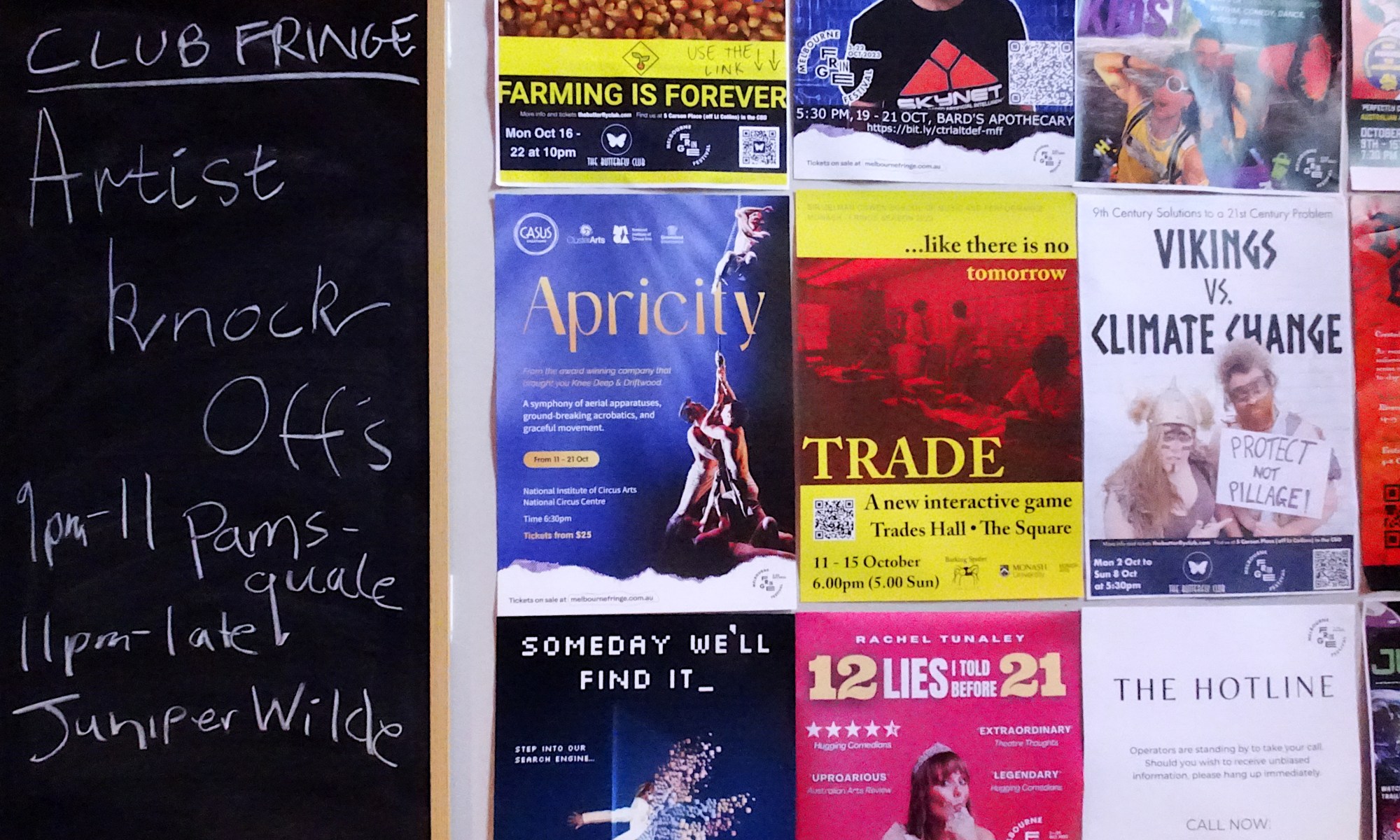
The latter, an indie work in the Melbourne Fringe Festival, disturbed me. The former, from the renowned Bangarra Dance Theatre, was sublime. Yet both achieved something that neither news hyperbole nor the lumpen lexicon of standard ideological squabble appear capable of. They inspired me to dig deeper into myself. Examine my reactions. Observe the influence of my preferences. Acknowledge the preconceived ideas I bring to the theatre.
This is what inspiration feels like. Permission to switch prisms. A chance to change the story.
1: Eva Stimson Clark. Check out her work on Instagram.
2: The Music. Published here in Australia in print and online.
 As If You Were Listening