

Journal of a pedestrian traveller
Words & images © Paul Ransom
WARNING: This is not a top 10 things to see on Jeju in 2024. Nor a 10 best Jeju eats guide. Furthermore, this piece contains no genuinely useful Jeju Island travel tips. It is instead the journal of an inexperienced solo wayfarer stumbling his way through a month of unplanned, out of focus immersion in the streets of a crumbly Korean city. Read at own peril.
Arrival
Thus it begins – a month on the island. Twenty-eight nights in a scruffy hotel in a narrow side street, where hodgepodge buildings hunker stoutly. Welcome to Jeju-do, a volcanic outcrop in the Yellow Sea off the south coast of Korea.
As it happens, today – April 3rd – is a significant date for the Jeju islanders. It marks the anniversary of a massacre1 perpetrated here in the late 1940s, but I had no idea about this when I booked my tickets in a rush of blood last November.
Rather, I was attracted to the island because of its natural beauty and its reputedly minimal ‘English support’. This is not a mega metropolis, nor is it gleaming. This neighbourhood, Samdo-i-dong, is crackled and labyrinthine. In a way it fits the cliché of the teeming and dirty Asian city, except that right now it is not teeming. More like hazy, with its veil of rain and the clouds in my head.
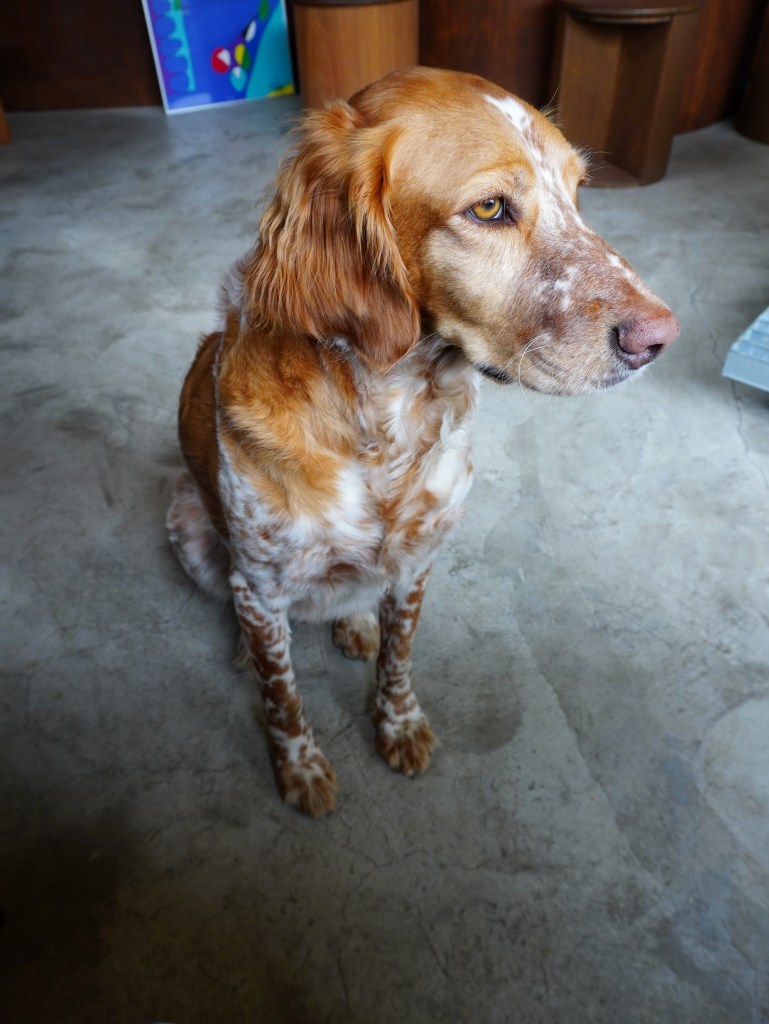
Yesterday, I woke up in my own bed in Melbourne and now, having barely slept for 30+ hours, I find myself in a cosy café drinking Americanos and befriending the resident dog, Angel. The ordinariness of it is surreal. I could be in any number of coffee shops at home in Australia but here I am thousands of miles away in what feels like a cross between K Drama and Scandinavian naturalism.
What strikes me most is that, after months of Googling and guessing, this is it. Alone, with minimal Korean, failing eyesight, and a blurred and possibly misguided rationale for being here.
Ahead of me now…the consequence of that choice.
Orientation
Three days in, and the abstraction of maps is becoming the reality of location, with names and tourist hype forming into streets, sprawling markets, and cherry blossoms.
Already, there is a sense of warmth and familiarity with the immediate surrounds – the Mugeungseong Village, as the woman in the alternative bookshop dubs it. Good coffee, cheap soju and beer, spicy kimbap, and Korean translations of Haruki Murakami are all within easy reach.
In addition, I have made my first Dongmun Market purchase: a tray of the island’s famed citrus from a smiling ‘eomma’ who did not seem to mind my fumbling Hangugeo*.
* Hangugeo = Korean (language). Hangul = Korean alphabet. Hanguk = Korea.
Here, of course, is the deeper challenge. The main topography is not physical, but linguistic, cultural, and personal. There is a complex landscape of manners, expectation, and other niceties to navigate, one which is doubtless beyond my full reckoning. As someone with only a smattering of Hangugeo gleaned from K Dramas and 90 Day Korean, I am at an automatic distance. I imagine I will spend the whole month on the periphery.
This is part of my motivation for being here. To be alien. Other. Not to belong. Like an extra on the set of a four week film. While there is a reflexive loneliness to it, there is an even greater sense of liberty. I know I will inadvertently break the rules of local custom – most likely offend some people – but then I will leave, and no one on this island will notice or care.
Perhaps this is what lives at the heart of travel; not so much exploration and broadening the mind, but the load-lightening gift of detachment. On Jeju-do, I could be anyone – which raises an interesting question. Who do I want to be, and is there a map for that?
Expansion/retraction
The nature of this journey was never simply tourist. It was always likely to be less spectacular than calderas and cascading waterfalls, nor as sanitised as museums and performative folk ritual. Indeed, my first week on Jeju-do has been an exercise in small scale immersion.
Aside from a couple of double-decker bus circuits of the city and nearby coastal spots, I have been travelling on foot. In this way, I have slowly and more intimately mapped this little corner of the world. Its countless side streets and laneways, the proliferation of outdoor gyms, the rows of empty bottles lingering outside closed bars. And, despite the presence of upmarket, Western branded retail, old people still sell fruit & veg kerbside, their goods spread out on cardboard. Meanwhile, jumbled shopfronts crammed with all manner of produce serve as a reminder of a merchant mentality that the shiny behemoth of franchise capitalism has yet to extinguish.
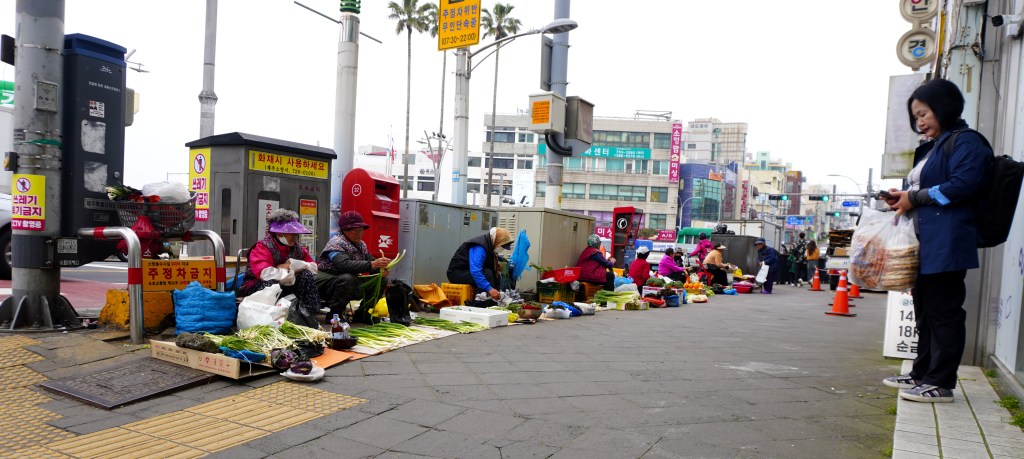
Here in the older part of Jeju-si, past and present mingle. QR Codes and rickety looking bicycles. Pay wave and wads of cash. Cool kids filming themselves while weathered old men shuffle by, heads down, going about their slow and unclickable business.
Like them, I walk, gradually expanding my range. Building my internal map; just as I have in Melbourne. Thus, while there is some disadvantage in not being able to drive2, the upside is the intimate cartography of gentle procession. The old men and I do not speed through the streets. In return, we are gifted their texture.
However, this does not mean I am immune to getting lost. It took the best part of an hour to stumble gratefully back onto the right path in one of the city’s public parks, having adventurously explored the lure of one too many tangents. I could have asked for help, but part of my reason for being here – solo and increasingly short sighted – is to test my limits. Physical and otherwise.
Indeed, the brute fact of visual decline and the more amorphous aspects of ageing have added an edge of discomfort and anxiety to the last week. Yet, as I type this morning, I am calm, if only because I have made peace with the idea of retraction. I don’t need to see the whole island, to tick things off a must-do list, or even have an ‘amazingly awesome time’.
Today, I might just amble around the neighbourhood with no particular goal in mind.
The bus experiment
Enough of the ambling, I thought. Why not try the bus tour thing? I mean, how bad can it be?
Answer: not just bad, not just cringeworthy, but…profoundly empty.
Yesterday’s south coast trip was token tourism at its vacuous best, little more than a series of hurried photo opps. Moreover, it highlighted the soulless commodification that host communities often fall foul of, turning themselves and their home into items of kitsch. If there were glimpses of the ‘real’ Jeju beneath the smear of the souvenir, they were the all-too-brief reminders that simply turning up in a bus and firing off a few shots is not just skimming the surface, it’s a kind of rolling absence. Here, but not really.
Hence the endless documentation. I was asked on numerous occasions to photograph my fellow tourists posing in front of rocky outcrops and mountaintop vistas, as though I were helping them gather evidence. Or was it that they all knew that, without the pictures, the day and the places would fade into a fog of forgetting. A box ticked, and nothing more.
- That said, the lowlight will live long in my memory. Advertised as a ‘living gallery’ that brings great works of art to life, it was in fact a supremely tacky monument to Insta-friendly vulgarity, bordering on desecration. What’s more, with its entirely Europhile ‘collection’ and amusement arcade aesthetic, it revealed nothing about Jeju; except perhaps its economic dependence on such trashy palaces of viral diversion. Sure, it was aimed at kids – so why take a bus load of adults there?
Yet, not all was lost or rendered as cheese. Maybe I am romanticising here, but at our final stop, at the foot of a beautiful waterfall3 cascading from a cliff directly into the sea, I was able to take a few moments to feel the fine mist. To linger in sensing. A short distance away, our tour guide, sat in similar repose. We exchanged a brief, wordless glance, a nod perhaps of recognition. In the photograph I took of her then, I now see the truest moment of the day. (But no, I will not share. She is not clickbait.)
Reverie # 1
A cool, humid evening. Birdsong. Pop music. Human chatter. The intermittent rumble of aircraft. I sit beside a stream, as lights from nearby restaurants take effect, and an illuminated suspension bridge casts a glow on softly rippling water. My skin is alive, almost cold. This is what I travelled for. Permission to stop.
Twenty minutes – maybe less – yet ample. On a bench overlooking Yongyeon Pond I feel the knots untying. For here there is presence. Delicacy and detail. The air and I are intimate. It enfolds me. I shiver lightly at its touch.
If I take no other memory of Jeju-do with me, no amusing anecdotes or sexy sounding travel tales, so be it. Maybe my mind will not be further broadened, but it has already been cleared. Not by epic scenery or exotic cuisine but by sitting still and watching the subtle fade of a cloudy dusk.
I am afloat here. Untethered to agenda or performance, nor even to an official version of self. Anonymously walking. Waiting, unnoticed, for the light to soften even more.
Lost/found
Here in my temporary and dilapidated domain – where the wearying, mid-century architecture is festooned with ribbons of bright, optimistic light – I am in the habit of walking different laps each day, nudging out the borders of familiarity.
Yet still, Jeju-si surprises me daily. Last week, a scrawny drunkard in Tamna Square held my hand tightly while telling me on repeat, with wide and earnest eyes, how much he liked me. (I like you may well have been his only English phrase.) Two afternoons ago, a hipster barista insisted his coffee was only available as “take-out” whilst proceeding to serve it to his other customers, all groovy looking kids from a 90s slacker fashion shoot. Then there was the taxi driver eating his supper outside a nearby CU store. He shared his dim-sims with me, and we used the Papago app to have a 15 minute conversation and establish the kind of impromptu bonhomie that only seems possible across barriers of language and culture. Strangers, finding connection despite.
Nevertheless, disconnects remain. Google Maps said one thing, the twisting topography begged to differ. My attempt to take a back route to Sarabong Peak, (there to walk amongst trees and enjoy the vista), became an hour long trudge through smog-shrouded streets. Nature may have eluded me, but I certainly got my fill of snaking, narrow byways and desiccated buildings.
It was like a scene from a Soviet realist drama; grim, grey and yet curiously unplanned. If I was nostalgic for quaintly cute industrial decay, I would have whistled revolutionary ditties as I stumbled myopically back to base camp.
- In Google’s defence, my eyesight may well have contributed to yesterday’s misadventure. That, (and Jeju-si’s embrace of tangents and trip hazards), has made navigation tricky. Actually, borderline unsafe. I am lucky not to have fallen flat on my face yet, nor be involved in serious mishaps with the right-sided traffic.
Hours later, having recovered from another lost vignette, I ventured out again. This time at night – typically velvety and cool – anticipating a Friday throng. But no! The streets were quiet. A surreal vacancy. The brightly lit, expensively branded edifice of Chilseonglo was all shop window, and no shoppers. As though it were a museum display. And here we see the hyper-coloured fossils of 21st century consumerism.
Not content to return to my room, I popped my head into one of the small and conspicuously empty bars across the road from my hotel – Machi Hakata – and there it was again. The beauty of this month long experiment. In a blink, the two staff and I connected over meakju (beer) and a fumbling concoction of Korean and English. A few minutes later we were joined by a couple of locals, one of whom produced a bottle of home brewed, carbonated rice wine, which he had spiced with chrysanthemum flowers. There followed a delightful, serendipitous hour.
We can see the sights, photograph ourselves in front of the requisite monuments, buy the appropriate souvenirs…or we can simply reside a while in the intimacy of human warmth. Some things we merely seek, others we are blessed to find.
This morning, I still have the glow. I am beginning to feel at home here in Samdo-i-dong and, in turn, it is starting to embrace me.
Stop/start
Jeju-do is famed for its natural wonders. This is why millions visit annually. However, as you may have gleaned, my sojourn has thus far been urban. Indeed, you could argue that I am a very poor traveller.
Despite multiple attempts, and hours online, I have thus far been unable to discern the workings of the island’s reputedly excellent public transport network. I have downloaded unintelligible maps, installed apps that did not deliver on their ‘English option’ promises, and been given conflicting information by tourist info services and well-meaning employees at the city’s main bus terminal. As for timetables…well no, they are not the done thing here on Jeju-do. All this, plus language and eyesight, have conspired to keep me well exercised. Good thing I love walking, and have been prepared to inhale lung-loads of smog.
Of course, my sense was that this epic bus-fail said more about my cultural biases and narrow world view than the design of local systems. Perhaps it also reeked of laziness and timidity. Fuck, maybe I’m getting too old for this.
Then, just as I was about to write myself off as an especially inept (mis)adventurer, one of my newfound Jeju friends – a tri-lingual jazz chanteuse I met in a nearby café – assured me that not all the blame was mine. Hype and reality, she revealed, do not necessarily align where the island’s buses are concerned.
Thereafter, she offered to take me for a countryside drive…and even if it doesn’t happen, at least now I won’t feel so haplessly Australian in this beautifully Korean world.
Texture
Into the final week…and how deeply we have dived. As the days tick down to departure, I move to a rhythm of routine and surprise, hovering somewhere between visitor and resident.
Already, familiar paths, familiar faces. We smile, wave, bow. Touch. Even hug! Meanwhile, Angel the dog rests her head on my lap as I drink Americanos and, beneath the rush of novelty, the delight of detail emerges.
Many travellers have remarked on the fascination of the ordinary. It is the interplay of small differences and welcome similarities that give our journeys their grain, reminding us that exotic locales are really just homes.
Here in Jeju-si, the presence of the hareubang, the so-called ‘stone grandfathers’, is one such detail. There are literally hundreds of these basalt statues in this neighbourhood alone. They adorn street corners, market lanes, café counters and sundry nooks. Carved from the volcanic rock the island itself is principally made of, they are totems associated with local myth, offering protection and conferring fertility. To the touch, they have a cool, textured solidity.
Less ancient, and almost as common, the communal recycling stations. Here the locals bring their pre-sorted plastics, etcetera. On my various walks I have seen this quiet ritual on numerous occasions. (Note: if this were instituted in Australia it would likely be regarded by many as an egregious inconvenience, if not a precursor to totalitarian thought control. Here on Jeju-do, however, it seems more like simple civic-mindedness, enacted without fuss.)
Likewise, people really do wait at the lights; and I have been happy to stand at car-less roadsides with them for the pre-recorded voice to give us permission to cross. There is something gentle and respectfully unrushed about it.
There is also a curious clustering phenomenon at play. Black pork street. Raw fish street. Noodle street. Along one road a gaggle of furniture stores. On another, a string of vintage clothing outlets. Elsewhere, a row of eyewear specialists. Indeed, there is also an area next to one of the canals where shouty old drunk men gather to stagger and yell random invective, like a kind of ageing pisshead precinct. (Put it on your must-see list, kids.)
Meanwhile, the bizarrely generous amount of shelf space afforded to Spam at the local ‘hypermarket’, the ready availability of absurdly cheap alcohol, and the colour-saturated curios of Korean TV continue to snag my attention. Like the ten-pin bowling advice show hosted by a stern, disciplinarian eomma that is as forensic as it is mysterious. How does this qualify for mainstream broadcast before 10pm on a Wednesday night? Who knows – but it’s all part of the journey into the fine print of life here in Samdo-i-dong.
Yet, for all the detail, the abiding universal. True, there are nuances. Quirks, customs, specifics. But the dominant note is that of unity. Humanity. The other is not so other. Not them. Nor merely I. Rather, us. And the texture of our togetherness.
Reverie # 2
A rare burst of crisp blue light in a month of cloud and haze. I sit outside, basking in a view of sea and sky, as sugar bright K Pop twinkles from café speakers and young women with lustrous black manes pause to photograph the panorama.
In this lovely temple of azure, I see clearly. I think of time – which is currency – and of joy. The what, where, how, and so on.
Right here, I realise, closing my eyes, breathing it in. Not so much the specific map reference, as the Rothko canvas of cerulean expanse. In the beautiful distance I am home again. Where everything I truly want resides.
Village
A couple of nights ago, in a cosy bar called Machi Hakata, the owner smiled and said, “This is your new village.”
As I contemplate flying out in 48 hours, I realise, with a discernible twinge of sadness, that he is right. Here in Samdo-i-dong – more so in the Mugeungseong Village – I am being embedded. Welcomed. Although the realist in me recognises the telltale signs of ‘holiday romance’, there is now a corner in my heart warmed by the embrace of this community.
We may never get to know one another deeply, but for a month we have touched, and in that brief space something of lasting value has passed between us. I have not seen all the sights, nor eaten all the dinners, but I have felt connected. I have met the other, (and so have they), and though we rarely had more than a handful of words in common, we spoke the deeper language.
So…what did I see in Jeju? Chingu. Friends. The uncle & niece team at my favourite watering hole, with their rice wine treats and spicy bar snacks. The chicken shop lady, with her maternal laughter and sparkling eyes; looking at me as if I were a lost child. (Which I may well be.) Likewise, the lady at Café Hug, who calls out and waves when she sees me walking by, and corrects my faulty Hangugeo whenever I stop for a juice. And next door, the Kimbap guy, who fist pumps me and plucks the cash right out of my hands, always at a discount. Meanwhile, two minutes away, in a cool and thoughtful space with indie tunes and a collection of books, the wonderful folk at Rhythm & Brews, where, on day one, I was introduced to the first of the Jeju chingu. Angel.
However, deepest of all, the three lovely souls I met at Café Songkee. Kim Nani and Baek Sungtan, the custodians, seem to have responded to me as something more than a regular customer. There is a bond of recognition between us, as though not having words we use other signs. Perhaps it is an artist thing, but maybe it is subtler than that.
Lastly, a friend of theirs: a jazz singing, tri-lingual iconoclast whose courage and intelligence – and whose willingness to reach across the innumerable barriers that potentially separated us – has helped to illuminate something vital about my own path. I will eat my final Jeju meal with her tomorrow night at a French restaurant we both love. Nestled, like a hidden gem, in one of the city’s innumerable side streets. Gomawo, Misun Renata Lee.
Thereafter…who knows…maybe one more soju with the villagers.
Bedroom
Melbourne. Bayside. A bright but crisp autumn afternoon. In a room with my things. The jumble of the familiar. Jeju is a series of jpegs now. A story. This.
I feel displaced. Not home, not elsewhere. In a few days, old routines will overwrite my island rhythms, and I will not miss my Korean friends quite so much. And they will meet new travellers, and raise their glasses to them in the same kind and familial way they did with me.
There is no nutshell take-out, no cute encapsulation, no star rating. It was not the volcano, it was the people, and the way we met. Across the sea. So often without words. None of which is a souvenir. Or useful trip advice.
It was a month…and I do not yet have the language to describe it.
PS: Should you have the inclination, here is a 32 minute video I captured whilst sitting on the sea wall near Yongyeon Pond.
1: The April 3rd Jeju Uprising, as it is widely known, was a local insurgency. In the aftermath of the Japanese colonial period and the partition of the Korean peninsula in the mid-late 1940s, many islanders began to protest UN/US sponsored elections. There are various readings of the motivation for their antipathy, and of the brutal response of mainland authorities and the American military. Either way, it is estimated that roughly ten percent of Jeju’s population were slaughtered in a government backed crackdown in 1948/9. I am led to believe that this is still a sensitive issue.
2: The congenital conditions which affect my eyesight have prevented me from obtaining a licence. Hence, an embrace of walking and public transport.
3: Jeongbang Falls, near Seogwipo on the island’s south coast. Definitely worth photographing, and lingering near the foot of.
 As If You Were Listening